
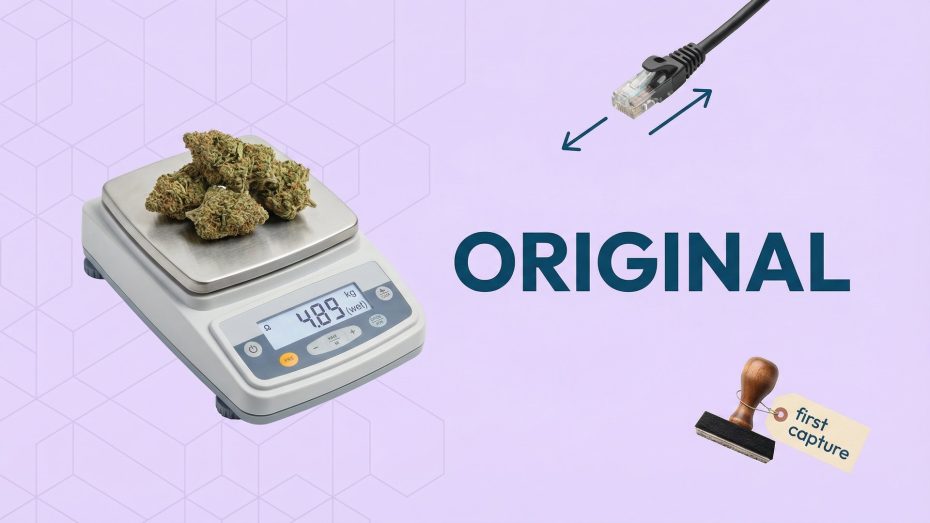

When an operator reads a scale and writes the weight on paper, is the number in your system still the original?
Original data recording cannabis facilities depend on is one of the most misunderstood principles in the ALCOA++ data integrity framework. The “O” in ALCOA stands for Original: the first capture of data is the true record, and every subsequent transcription is a copy that introduces risk. In a cannabis production environment where weights determine regulatory reporting, tax calculations, and inventory accuracy, the difference between an original record and a transcribed copy is not academic. It is the difference between data an inspector trusts and data an inspector questions.
This guide explains what the Original principle requires under PIC/S PI 041-1, why the standard paper-scale-computer workflow in most cannabis facilities fails this principle, and how direct hardware integration between scales and data capture systems eliminates the transcription chain entirely. For the full ALCOA++ framework applied to cannabis, see our comprehensive guide on ALCOA++ data integrity for cannabis manufacturing.
What Does “Original” Mean in ALCOA++ Data Integrity?
The Original principle requires that the first capture of information is preserved as the true record. PIC/S PI 041-1, the definitive international guidance on data integrity in GMP environments, states that “original records (or verified true copies) must be preserved” and that “transcription introduces risk” (PIC/S PI 041-1, 2021). The World Health Organisation’s TRS 996 Annex 5 reinforces this position, requiring that data integrity be maintained from creation through every subsequent phase of the record lifecycle (WHO TRS 996 Annex 5).
In practical terms, the Original principle asks a simple question about every data point in your system: is this the first time this value was recorded, or has it been copied from somewhere else? If an operator reads a weight from a scale display, writes it on a clipboard, and later types it into software, the software entry is not the original. The original was the scale reading. The clipboard note is a first-generation copy. The software entry is a second-generation copy. Each copy introduces a new opportunity for error, and each step further removes the record from its source.
Under PIC/S guidance, when transcription from an original record to another system is necessary, the process must include verification steps to confirm the transcribed copy matches the original. Without those verified true copy procedures, a transcribed record does not meet the Original principle. Most cannabis facilities that rely on paper-based workflows have no such verification in place.
Why Does Original Data Recording Matter for Cannabis Producers?
Because weight is the single most consequential data point in cannabis manufacturing, and transcription errors in weight records cascade through every downstream system.
Health Canada’s Good Production Practices require licence holders to retain documentation demonstrating compliance with Cannabis Regulations Part 5, including batch records that contain weight measurements at multiple stages: harvest, drying, processing, and packaging (Health Canada GPP Guide). These weights flow into Health Canada Reporting (HCR), determine excise tax calculations, and form the basis of inventory reconciliation. A transcription error at any point in the chain can propagate through regulatory filings, financial records, and compliance documentation.
The risk is not theoretical. Health Canada conducted 889 inspections of cannabis licence holders in FY 2024-2025, issuing 37 non-compliant reports where document retention was a named finding category (Health Canada, 2025). When an inspector examines a batch record and finds that the weight in the system does not match the weight on a paper log (or that no paper log exists to verify the system weight), the question of originality becomes central to the finding.
Beyond Health Canada, global regulatory bodies are converging on stricter data integrity expectations. The FDA’s 21 CFR Part 11 requires validated electronic records and audit trails. The revised EU GMP Annex 11, expected to be finalised in mid-2026, explicitly references ALCOA+ for the first time in EU GMP text and expanded from 5 pages to 19 pages (PharmOut, 2025). Cannabis producers targeting international export markets or EU GMP certification benefit from ensuring their weight records are original, not transcribed copies.
How Does the Paper-Scale-Computer Chain Fail Original Data Recording?
The standard workflow in most cannabis facilities creates a three-step transcription chain where the system record is two generations removed from the original measurement. Here is how it typically works.
Step 1: The Scale Reading (the actual original)
An operator places a bag of dried cannabis on a bench scale. The scale display shows 487.3 grams. This is the original data point: the first electronic capture of the weight by calibrated hardware.
Step 2: The Paper Note (first copy)
The operator reads the display and writes “487.3 g” on a clipboard, notebook, or paper batch record form. This is already a copy. The operator may have read the display before it fully stabilised. They may have transposed digits. They may have rounded. The paper note is not the original; it is a human interpretation of the original.
Step 3: The System Entry (copy of a copy)
Later (sometimes hours later, at the end of a shift), the operator or a data entry clerk walks to a desktop computer and types “487.3 g” into the seed-to-sale system. This is a copy of a copy. A new set of transcription risks is introduced: the operator may misread their own handwriting, transpose digits while typing, or enter the weight against the wrong lot number. The system timestamp reflects when the data was typed, not when the weighing occurred, which also violates the Contemporaneous principle.
Each step in this chain multiplies the probability of error. Research on manual transcription in regulated environments consistently finds error rates between 0.5% and 2% per transcription step. In a facility processing hundreds of weights per day across harvesting, drying, processing, and packaging, even a 1% error rate produces multiple inaccurate records every shift.
| Step | Record Type | Original? | Risk Introduced |
|---|---|---|---|
| 1. Scale display | Electronic measurement by calibrated hardware | Yes | None (if scale is calibrated and reading is stable) |
| 2. Paper notation | Handwritten copy of display reading | No (first copy) | Misread display, premature reading, rounding, illegible handwriting |
| 3. System entry | Typed copy of paper notation | No (second copy) | Transposed digits, wrong lot number, delayed entry, misread handwriting |
From an inspector’s perspective, the system entry (Step 3) is the record of record. But it is two transcription steps removed from the original measurement. If the inspector asks “how do you know this weight is correct?” the only honest answer is “because someone wrote it down and someone else typed it in.” That answer does not satisfy the Original principle.
GrowerIQ Mobile Scanner
See how it supports original data recording on the facility floor
Weights flow directly from the scale to your database, with no intermediate transcription.
Explore the Scanner →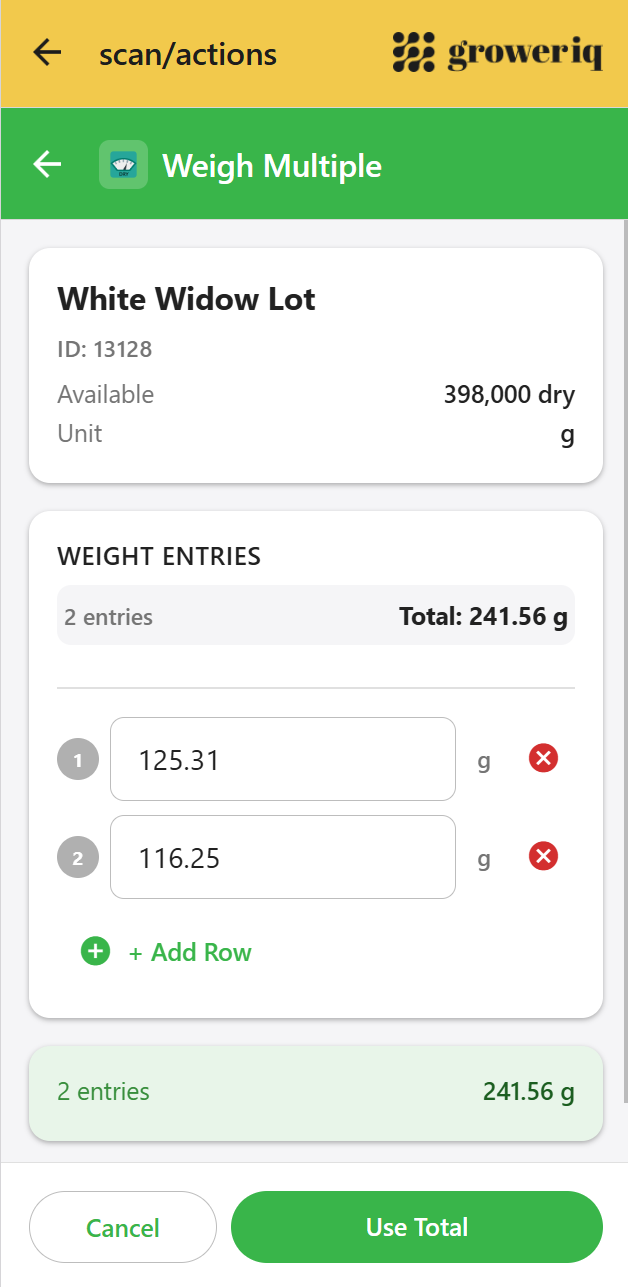
How Does Direct Scale Integration Support Original Data Recording in Cannabis?
By eliminating the paper and re-keying steps entirely, so the digital record becomes the original.
When a data capture device communicates directly with a scale over a TCP/IP network connection, the weight value flows from the scale’s electronic sensor through the communication protocol, into the application, and straight to the database. There is no intermediate notebook. There is no re-keying at a desktop. The value that appears in the system is the value the scale measured. The digital record is the original.
What Direct Integration Looks Like in Practice
GrowerIQ’s mobile scanner connects to networked laboratory and bench scales over TCP socket connections. The scanner supports four scale communication protocols: Mettler Toledo, OHAUS Ranger 3000, T32XW, and PR-Series. When an operator taps “Read Scale” on the scanner screen, the device opens a TCP connection to the scale, reads the weight value using the appropriate protocol parser, and populates the form field automatically. The operator confirms the reading and submits. The weight flows from scale hardware to the form field to the API to the database, with no human transcription at any point.
Stability detection adds another layer of integrity. The scanner waits for the scale to indicate that the reading has stabilised before accepting the value, preventing premature captures that could record an inaccurate weight while the load is still settling. This addresses one of the risks present even in Step 1 of the paper workflow: an operator reading the display before it settles.
For more detail on selecting scales that support direct integration, see our guide on choosing compliant scales for cannabis operations.
Paper Workflow vs Direct Scale Integration: Which Supports Original Data Recording?
The following table compares the paper-based transcription workflow against direct scale-to-system integration across the key dimensions of the Original principle.
| Dimension | Paper Workflow | Direct Scale Integration |
|---|---|---|
| Is the system record the original? | No. It is a copy of a copy (scale to paper to system). | Supported. The digital record is the first capture after the scale measurement. |
| Number of transcription steps | Two (scale to paper, paper to system) | Zero. Weight flows directly from scale to system. |
| Risk of transposition errors | Present at each transcription step | Eliminated. No human reads or types the weight. |
| Stability verification | Depends on operator judgement (may read before settling) | Supported. Stability detection waits for settled reading. |
| Verified true copy procedures | Rarely implemented; most facilities have no formal verification | Not needed. The record is the original, not a copy. |
| Inspector confidence | Low. No way to verify the system value matches the scale reading. | Supported. The data path from scale to system is auditable. |
How Does Original Data Recording Connect to Other ALCOA++ Principles?
The Original principle does not exist in isolation. It intersects directly with at least three other ALCOA++ principles, and failures in one often indicate failures in others.
Contemporaneous: When weight data is transcribed from paper to system after the fact, the record fails both Original (it is a copy) and Contemporaneous (it was not entered at the time of the activity). Direct scale integration addresses both simultaneously: the weight is captured at the moment of weighing and the digital record is the original.
Accurate: Each transcription step introduces error risk. Eliminating transcription supports the Accurate principle by removing the most common source of weight errors in cannabis facilities: human re-keying.
Traceable: When the original record is the digital entry, the complete data path from scale measurement to database is auditable. Every record includes the user who captured it, the timestamp of capture, and the inventory item it applies to, creating unbroken traceability from measurement to regulatory filing.
For a detailed look at how all 10 ALCOA++ principles apply to cannabis manufacturing, see our complete ALCOA++ data integrity guide.
Key Takeaways
- The Original principle requires that the first capture of data is the true record. Transcription from paper to system creates copies, not originals, and each copy introduces risk.
- The standard paper-scale-computer workflow creates a two-step transcription chain. The system entry is two generations removed from the scale measurement, violating the Original principle.
- Direct scale integration eliminates transcription entirely. When the scale communicates directly with the data capture system, the digital record becomes the original.
- Weight is the most consequential data point in cannabis manufacturing. Transcription errors in weights cascade through regulatory reporting, tax calculations, and inventory reconciliation.
- Originality intersects with Contemporaneous, Accurate, and Traceable. Fixing the Original gap often addresses multiple ALCOA++ principles simultaneously.
Frequently Asked Questions
What counts as an “original record” under ALCOA++ for cannabis weight data?
The original record is the first electronic capture of the weight by calibrated scale hardware. If that value is transcribed to paper and then re-keyed into software, the software entry is a copy, not the original. Direct integration between the scale and the data capture system makes the digital entry the original record.
Can a paper record be considered a “verified true copy” under PIC/S guidance?
Yes, but only if the facility has documented verified true copy procedures that include independent verification of the transcription against the original source. Most cannabis facilities using paper-based workflows do not have these procedures in place, which means their paper records are unverified copies rather than verified true copies.
Does original data recording in cannabis require specific scale hardware?
Direct integration requires scales with network communication capability (typically TCP/IP). Common laboratory and bench scales from manufacturers such as Mettler Toledo, OHAUS, and others support this. Not all scale models have network interfaces; see our guide on choosing compliant scales for cannabis operations for details on compatible hardware.
How does original data recording affect Health Canada inspections?
When an inspector reviews batch records, they look for evidence that weights and measurements are trustworthy. If the facility can demonstrate that weight data flows directly from calibrated scale hardware into the system with no intermediate transcription, the inspector has a clear, auditable data path. Transcribed records, by contrast, require the facility to prove that each transcription step was verified, which is difficult without documented procedures.
Validation Disclaimer: ALCOA++ data integrity is achieved through validated processes at your facility. GrowerIQ provides the software foundation that supports each ALCOA++ principle; your quality team completes the validation documentation (IQ/OQ/PQ) as part of your facility’s quality management system.
Last updated: March 2026
See How Direct Scale Integration Supports Original Data Recording
GrowerIQ’s mobile scanner connects directly to networked scales, making the digital record the original. The first seed-to-sale mobile scanner with native live scale integration.
EXPLORE SCANNER REQUEST DEMOAbout GrowerIQ
GrowerIQ is changing the way producers use software - transforming a regulatory requirement into a robust platform to learn, analyze, and improve performance.
To find out more about GrowerIQ and how we can help, fill out the form to the right, start a chat, or contact us.