


Would your batch records from two years ago still be legible if Health Canada asked for them today?
Enduring records cannabis audit trail requirements exist for one reason: data that disappears, degrades, or becomes unreadable before the retention period expires is the same as data that was never recorded. The Enduring principle is the eighth component of the ALCOA++ data integrity framework, and it addresses a risk that cannabis facilities consistently underestimate. Records stored on thermal paper, in damp production environments, or on unbackuped local machines are one hardware failure, one spill, or one forgotten binder away from permanent loss. When Health Canada conducts an inspection and requests batch documentation from 18 months ago, the records must be intact, complete, and readable on the spot.
This guide defines what “Enduring” means under international GMP standards, explains why it carries particular weight for cannabis manufacturing under Health Canada’s record retention requirements, identifies where paper and poorly managed digital records fail, and outlines how immutable audit trails with structured before-and-after snapshots close the gap. This article is part of our comprehensive ALCOA++ Data Integrity for Cannabis Manufacturing guide.
What Does “Enduring” Mean for Cannabis Data Integrity?
The regulatory definition is precise. PIC/S PI 041-1, the definitive international guidance on data integrity published by the Pharmaceutical Inspection Co-operation Scheme (whose member authorities include Health Canada), states that data must be “recorded on permanent media” and “durable for the entire retention period.” The WHO TRS 996 Annex 5 uses similar language: records must be maintained in a way that ensures they are “available, accessible, and readable throughout the retention period.”
In practical terms, the Enduring principle requires that every batch record, every weight entry, every quality inspection, and every deviation report remains physically intact and fully readable for the entire time the regulation says you must keep it. For cannabis licence holders in Canada, the Cannabis Regulations (Part 11, Sections 231-232) require retention of documentation for at least two years after it is replaced or after the licence expires. But “enduring” is not just about the calendar. The record must survive the conditions of its storage environment. A batch record that existed two years ago but is now water-damaged, faded, or stored on a failed hard drive does not satisfy the principle.
The Enduring principle is closely related to two other ALCOA++ requirements. Records that are enduring but not Available (retrievable on demand during an inspection) fail at the point of need. Records that are enduring but no longer Legible (readable and unambiguous) have survived in form but not in function. All three principles work together: a record must persist, remain readable, and be accessible throughout its retention period.
Why Do Cannabis Records Fail the Enduring Principle?
Because the production environment actively destroys the media that most cannabis facilities use to store their records, and digital storage without proper architecture is not much better.
Paper Records in Production Environments
Cannabis production environments are hostile to paper. Grow rooms maintain high humidity levels. Processing areas involve water, solvents, and organic material. Packaging areas generate dust and debris. Paper batch records that travel through these environments accumulate moisture damage, stains, tears, and wear. Binders stored in production-adjacent areas are exposed to the same conditions over months and years.
Thermal paper is particularly vulnerable. Scale receipts, label printer outputs, and register tapes printed on thermal paper begin fading within weeks of printing and can become completely blank within six to twelve months, well within the two-year minimum retention period. A facility that relies on thermal printouts as supporting documentation for batch records is building its compliance case on media that will not survive to be inspected.
Unmanaged Digital Storage
Moving from paper to digital does not automatically satisfy the Enduring principle. Spreadsheets saved on a single local workstation, USB drives passed between operators, and databases without backup procedures are all vulnerable to hardware failure, accidental deletion, and data corruption. A facility that migrated its records to Excel files on one desktop computer has traded paper degradation for a different single point of failure.
The risk is compounded when digital records lack audit trails. If a record can be silently modified or deleted without any trace, the system cannot demonstrate that the current version of a record is the same one that was originally created. The Enduring principle requires not just that data persists, but that its integrity can be verified across the retention period.
Hybrid Workflows: The Worst of Both Worlds
Many cannabis facilities operate in a hybrid mode: some records in a seed-to-sale platform, some on paper forms, some in spreadsheets, and some as photos stored on personal devices. This fragmentation means that no single system can guarantee the enduring availability of the complete batch record. When an inspector requests documentation, staff must assemble records from multiple locations, and the probability that something has been lost, corrupted, or degraded increases with every additional storage location.
GrowerIQ Mobile Scanner
See how it supports enduring audit trails on the facility floor
Every activity permanently stored with immutable before-and-after change snapshots.
Explore the Scanner →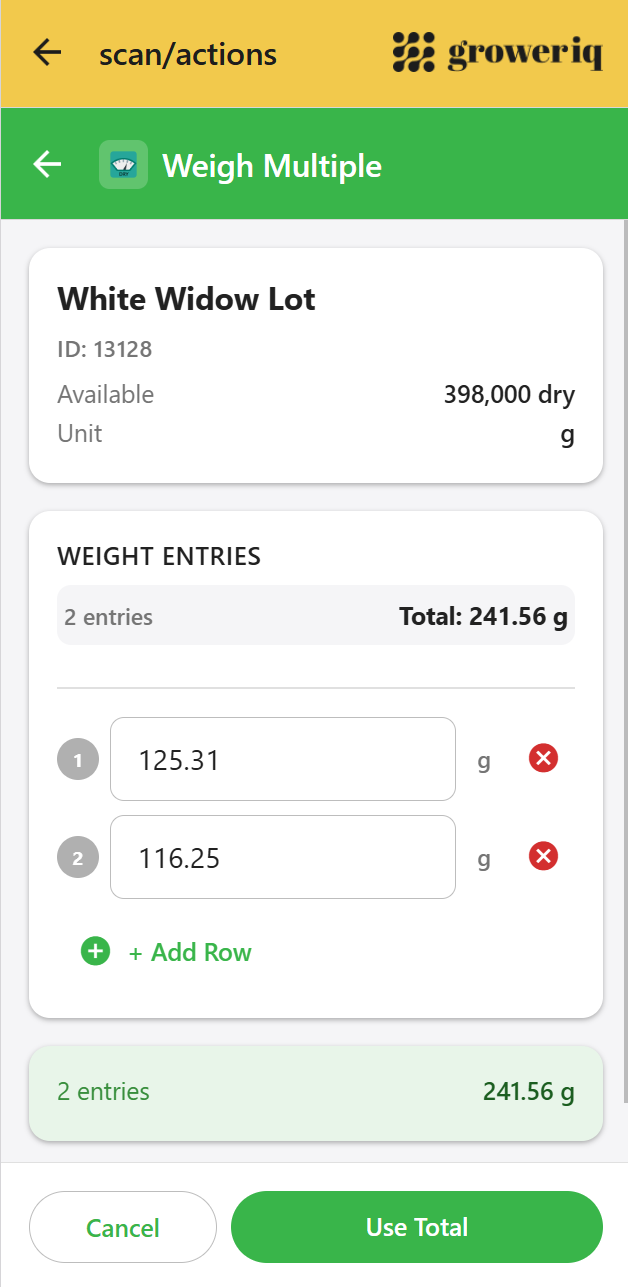
What Does an Enduring Records Cannabis Audit Trail Look Like?
An audit trail that satisfies the Enduring principle has four characteristics: records are stored in a professionally managed database, every change is permanently logged, no record can be silently deleted, and the entire history is preserved with enough detail to reconstruct the state of any record at any point in time.
Immutable Activity History
The foundation of an enduring audit trail is a dedicated history table that captures every change to every record. When an activity is created, the system logs the creation event with the full data payload, the identity of the person who created it (drawn from their authentication token), and the timestamp. When a record is subsequently modified, the system captures both the before-state and the after-state as structured data snapshots, along with who made the change and when. This before/after pattern means the complete lifecycle of every record is preserved, not just its current state.
GrowerIQ implements this through a dedicated ActivitiesHistory table in PostgreSQL. Every CREATE, UPDATE, and DELETE event generates a history entry with before-and-after JSONB snapshots, a changed_by user reference, and a changed_at timestamp. The history table is append-only by design: entries are never modified or removed. This creates an immutable journal that an inspector can review to see exactly how any record evolved from its original state to its current form.
Soft Delete: Records Never Disappear
In a system designed for enduring records, deletion does not mean destruction. When an activity needs to be removed from active use, the system sets a “deleted” flag on the record rather than physically removing it from the database. The record remains in storage, fully intact, with its complete history. An “edited” boolean flag marks any record that has been modified after initial creation, providing immediate visibility into which records have been changed.
This soft-delete approach serves two purposes. First, it prevents accidental or intentional destruction of records during the retention period. Second, it preserves the audit trail: an inspector can see that a record was created, later modified, and eventually marked as deleted, with full details of who performed each action and when. There is no gap in the record’s lifecycle.
Structured Data in a Managed Database
PostgreSQL (or any enterprise-grade relational database) provides the storage foundation that paper, spreadsheets, and USB drives cannot. Records stored in a properly managed database benefit from automated backups, point-in-time recovery, data integrity constraints, and access controls that prevent unauthorised modification. The database does not fade, get wet, or lose data because someone forgot to save a file.
Structured JSONB storage for activity payloads means that every data point captured on the production floor (weights, inspection results, lot numbers, environmental readings) is stored in a queryable format that remains accessible regardless of how the user interface evolves over time. The data is not locked in a proprietary format or dependent on a specific application version to read.
Paper vs Digital: How Does Each Approach Handle Enduring Records?
| Enduring Requirement | Paper-Based | Digital (Immutable Audit Trail) |
|---|---|---|
| Survives production environment | Fail. Moisture, spills, and handling degrade paper within months. | Supported. Database not affected by production floor conditions. |
| Readable across retention period | Fail. Thermal paper fades; ink smears; handwriting varies. | Supported. Machine-generated records remain identical over time. |
| Protected from accidental destruction | Not supported. Paper can be lost, misfiled, or physically destroyed. | Supported. Soft delete preserves records; backups protect against hardware failure. |
| Change history preserved | Partial. Cross-outs with initials, if followed. No before/after snapshots. | Supported. Dedicated history table with before/after JSONB snapshots on every change. |
| Deletion tracked | Not supported. Paper records can be discarded without trace. | Supported. Soft delete flags the record; deletion event logged in history with user identity and timestamp. |
| Backup and recovery | Not supported. Paper has no backup mechanism. | Supported. Automated database backups with point-in-time recovery. |
The structural gap is clear. Paper records are inherently temporary media in the context of cannabis production environments. Even paper stored in climate-controlled offices degrades over time and is vulnerable to physical loss. Digital records in a managed database with immutable audit trails satisfy the Enduring principle by design, provided the database infrastructure includes proper backup procedures, access controls, and disaster recovery.
Key Takeaways
- Enduring means records survive the full retention period intact: Per PIC/S PI 041-1, data must be stored on permanent media and remain durable, readable, and verifiable for as long as the regulation requires retention.
- Paper is temporary media in cannabis production environments: Moisture, spills, thermal fading, and physical handling make paper inherently unsuitable for multi-year retention in production-adjacent storage.
- Digital storage alone is not enough: Spreadsheets on unbackuped machines, USB drives, and databases without audit trails still fail the Enduring principle. The storage must include immutable history, soft delete, and automated backups.
- Before/after snapshots preserve the full record lifecycle: A dedicated history table that captures every CREATE, UPDATE, and DELETE with structured data snapshots, user identity, and timestamps creates the permanent audit journal that inspectors require.
- Enduring works with Available and Legible: A record that persists but cannot be found (Available) or read (Legible) fails at the point of need. All three principles must be satisfied together.
Frequently Asked Questions
What does the Enduring principle mean for a cannabis audit trail?
The Enduring principle requires that all records, including batch records, weight entries, inspection results, and deviation reports, are stored on permanent, secure media for the entire retention period. For cannabis licence holders in Canada, this means at least two years after the documentation is replaced or the licence expires. The records must remain intact, readable, and verifiable throughout that period, not just at the time of creation.
Does moving to a digital system automatically satisfy the Enduring principle?
No. Digital storage satisfies the Enduring principle only if the system includes automated backups, access controls that prevent unauthorised modification, and immutable audit trails that log every change with before-and-after snapshots and user identity. Spreadsheets on a single unbackuped machine, or a database without audit trails, trade paper degradation for digital fragility. The storage infrastructure matters as much as the format.
How long must cannabis records be retained in Canada?
Under Cannabis Regulations Part 11 (Sections 231-232), documentation demonstrating compliance with Good Production Practices and Quality Assurance requirements must be retained for at least two years after it is replaced or after the licence expires. Some specific record types may have longer retention requirements. The Enduring principle demands that these records remain on permanent media for the full duration of the retention period.
What is the difference between Enduring and Available in ALCOA++?
Enduring focuses on persistence: the record must physically survive in a readable state for the entire retention period. Available focuses on accessibility: the record must be retrievable without delay when an inspector or internal reviewer requests it. A record locked in a filing cabinet that no one can find is enduring but not available. A record in a searchable database with automated backups satisfies both principles. The two work together: persistence without accessibility, or accessibility without persistence, both fail the standard.
Validation Disclaimer: ALCOA++ data integrity is achieved through validated processes at your facility. GrowerIQ provides the software foundation that supports each ALCOA++ principle; your quality team completes the validation documentation (IQ/OQ/PQ) as part of your facility’s quality management system.
Last updated: March 2026
See How Immutable Audit Trails Support Enduring Records Cannabis Audit Trail Requirements
Every record creation, modification, and deletion is permanently logged with before/after snapshots, user identity, and timestamps. Records persist, intact and queryable, for the full retention period. See how the mobile scanner supports enduring records.
EXPLORE SCANNER
About GrowerIQ
GrowerIQ is changing the way producers use software - transforming a regulatory requirement into a robust platform to learn, analyze, and improve performance.
To find out more about GrowerIQ and how we can help, fill out the form to the right, start a chat, or contact us.