
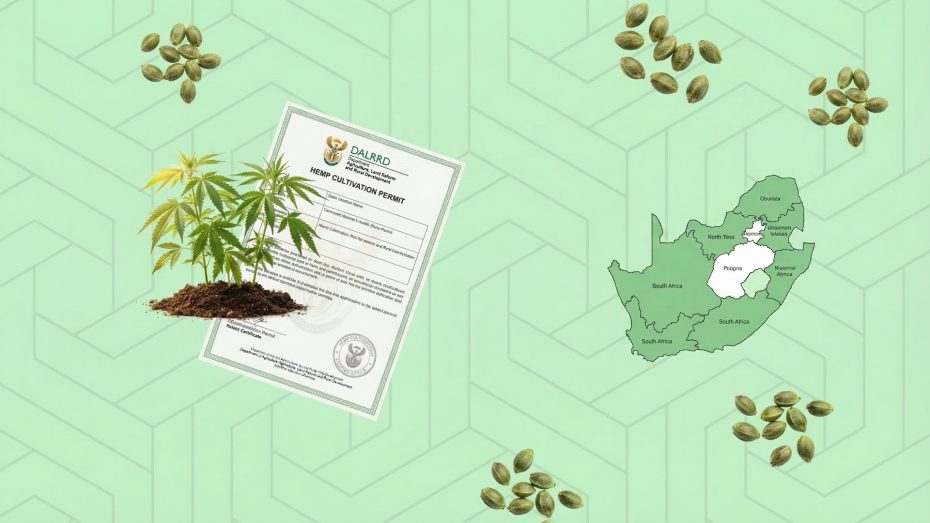

South Africa became the most permissive country in the world for industrial hemp on December 1, 2025, when the new Plant Improvement Act raised the THC threshold from 0.2% to 2% — a tenfold increase that no other nation matches. With a domestic cannabis market estimated at R14 billion and government targeting 10% annual growth, understanding South Africa hemp cultivation regulations has never been more critical for cultivators, investors, and compliance officers.
But here is what many guides miss: while the regulations are national, the practical reality of hemp farming in South Africa varies dramatically from province to province. Climate suitability, government support programs, permit volumes, and infrastructure differ across every region. KwaZulu-Natal has distributed 664 permits and committed R47 million to cannabis research. The Eastern Cape is targeting 100,000 hectares of production with international partnerships. The Free State offers vast flat land ideal for mechanized operations.
This guide breaks down the national regulatory framework, walks through each province’s hemp landscape, covers the licensing process and compliance requirements, and explains what the 2026 regulatory calendar means for cultivators entering or scaling in South Africa’s hemp sector.
Understanding South Africa Hemp Cultivation Regulations in 2026
The Dual-Track System: DALRRD vs. SAHPRA
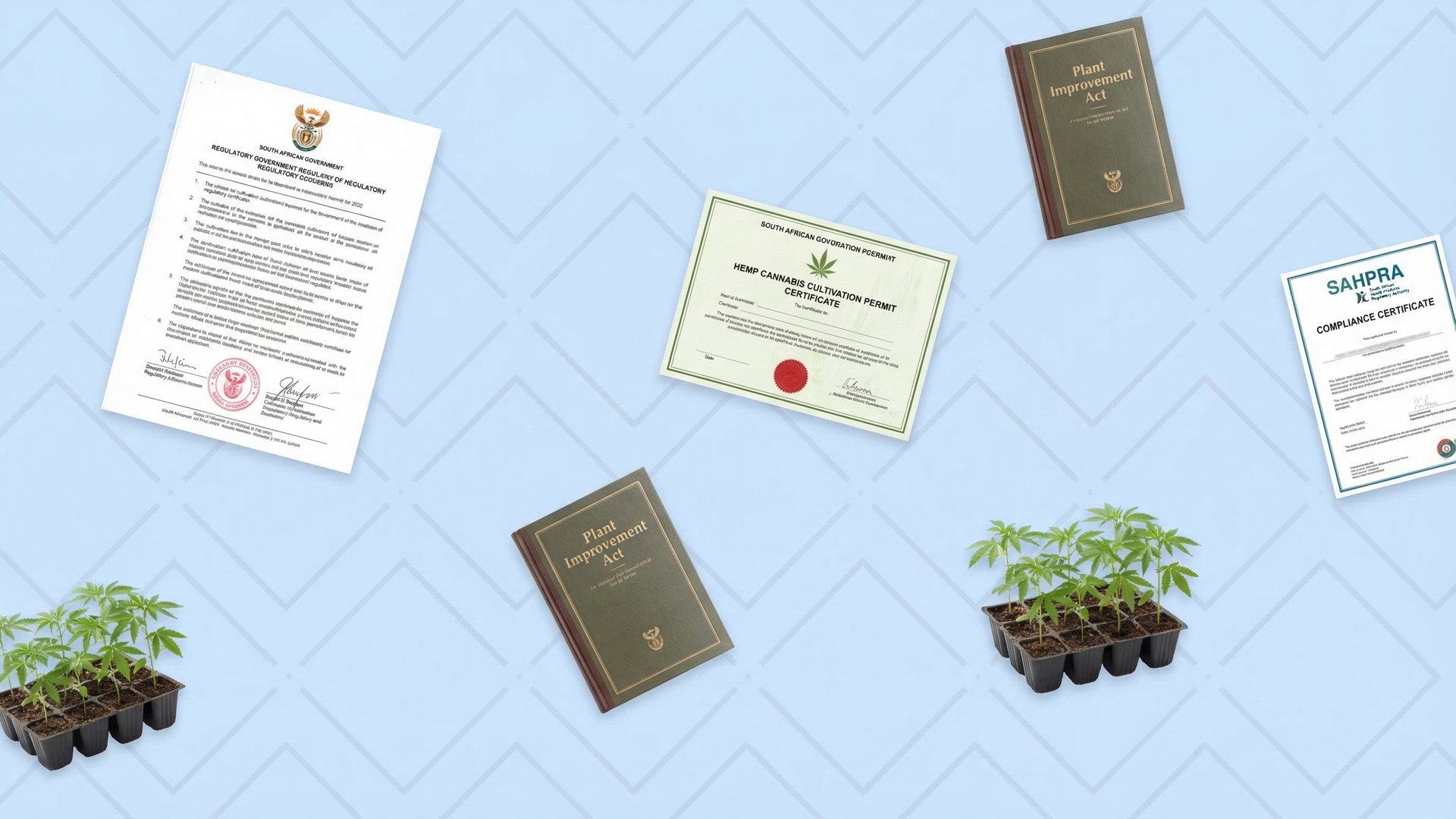
South Africa operates a dual-track regulatory system that separates hemp from medicinal cannabis under two different government bodies. Anyone looking to learn how to get a cannabis license in South Africa must first understand which track applies to their operation.
DALRRD (Department of Agriculture, Land Reform and Rural Development) issues hemp permits under the Plant Improvement Act. These permits cover cultivation, propagation, breeding and research, seed cleaning and conditioning, sale, import, and export. Each permit allows a maximum of 50 hectares of cultivation, and the application fee is R902. As of September 2025, DALRRD had issued a cumulative 1,408 hemp permits — up from 1,110 in September 2024 and just 371 in earlier periods.
SAHPRA (South African Health Products Regulatory Authority) issues Section 22C licenses for medicinal cannabis cultivation and manufacturing. These licenses are limited to medicinal and research purposes, cost R23,980 to apply for, and are valid for five years. Since 2022, SAHPRA has issued 83 cannabis licenses, 4 manufacturing licenses, 120 export licenses, and 30 research permits.
A third body, the DTIC (Department of Trade, Industry and Competition), manages the National Cannabis Master Plan and the forthcoming Hemp and Cannabis Commercialisation Policy expected for Cabinet approval in April 2026. The DTIC’s mandate is to centralize policy and accelerate commercial development of the sector.
Hemp vs. Dagga: What the Law Actually Says
South African law draws a clear line between hemp and dagga (the colloquial term for cannabis/marijuana):
- Hemp is defined under the Plant Improvement Act 2018 as Cannabis sativa L. cultivated for agricultural or industrial purposes, with leaves and flowering heads containing no more than 2% THC. It is legal for commercial cultivation with a DALRRD permit.
- Dagga refers to cannabis with THC above the 2% threshold. Private adult use has been decriminalized under the Cannabis for Private Purposes Act (signed May 29, 2024), which allows possession of up to 750 grams of dried cannabis and cultivation of up to 5 plants per adult. However, commercial dagga cultivation is only permitted with a SAHPRA Section 22C license for medicinal or research purposes.
The Overarching Cannabis Bill, expected to be presented to Parliament by mid-2027, will eventually unify these separate regulatory tracks into a single comprehensive framework. Until then, cultivators must navigate the current South Africa dagga regulations carefully to ensure they operate under the correct permit or license.
The 2% THC Game-Changer: Why South Africa Leads the World
What Changed on December 1, 2025
The Plant Improvement Act No. 11 of 2018 came into operation on December 1, 2025, replacing the outdated Plant Improvement Act No. 53 of 1976. The most significant change was raising the THC limit for industrial hemp from 0.2% to 2% — making South Africa the only country in the world to allow more than 1% total THC in an industrial hemp plant.
This decision was driven by scientific recognition that the previous 0.2% limit was too restrictive for South Africa’s local climate conditions and available cultivars. Many hemp varieties naturally produce THC levels that exceed 0.2% in warmer climates, which meant South African farmers faced disproportionate risk of non-compliance compared to their European or North American counterparts.
What the Higher Threshold Means for Growers
The tenfold increase in the THC limit changes the economics and risk profile of hemp cultivation in South Africa:
- Dramatically lower non-compliance risk. Farmers no longer face the constant threat of “hot crops” — plants that test above the legal threshold due to climate or genetic variability.
- Wider cultivar selection. A broader range of commercially viable hemp varieties becomes available, including CBD-rich and dual-purpose cultivars that were previously off-limits.
- Increased investor confidence. International seed suppliers and investors now view South Africa as a more stable regulatory environment for hemp operations.
- Improved economic viability. Higher-THC hemp varieties tend to produce more valuable biomass, particularly for CBD extraction and value-added products.
The tenfold increase in the THC threshold fundamentally improves the viability of South Africa hemp cultivation regulations for commercial growers worldwide.
About 480 agricultural advisers and 556 hemp permit holders have already received technical training on cultivation, regulatory compliance, and post-harvest processing to prepare for this new regulatory environment.
South Africa Cannabis Growing by Province: Where to Cultivate Hemp
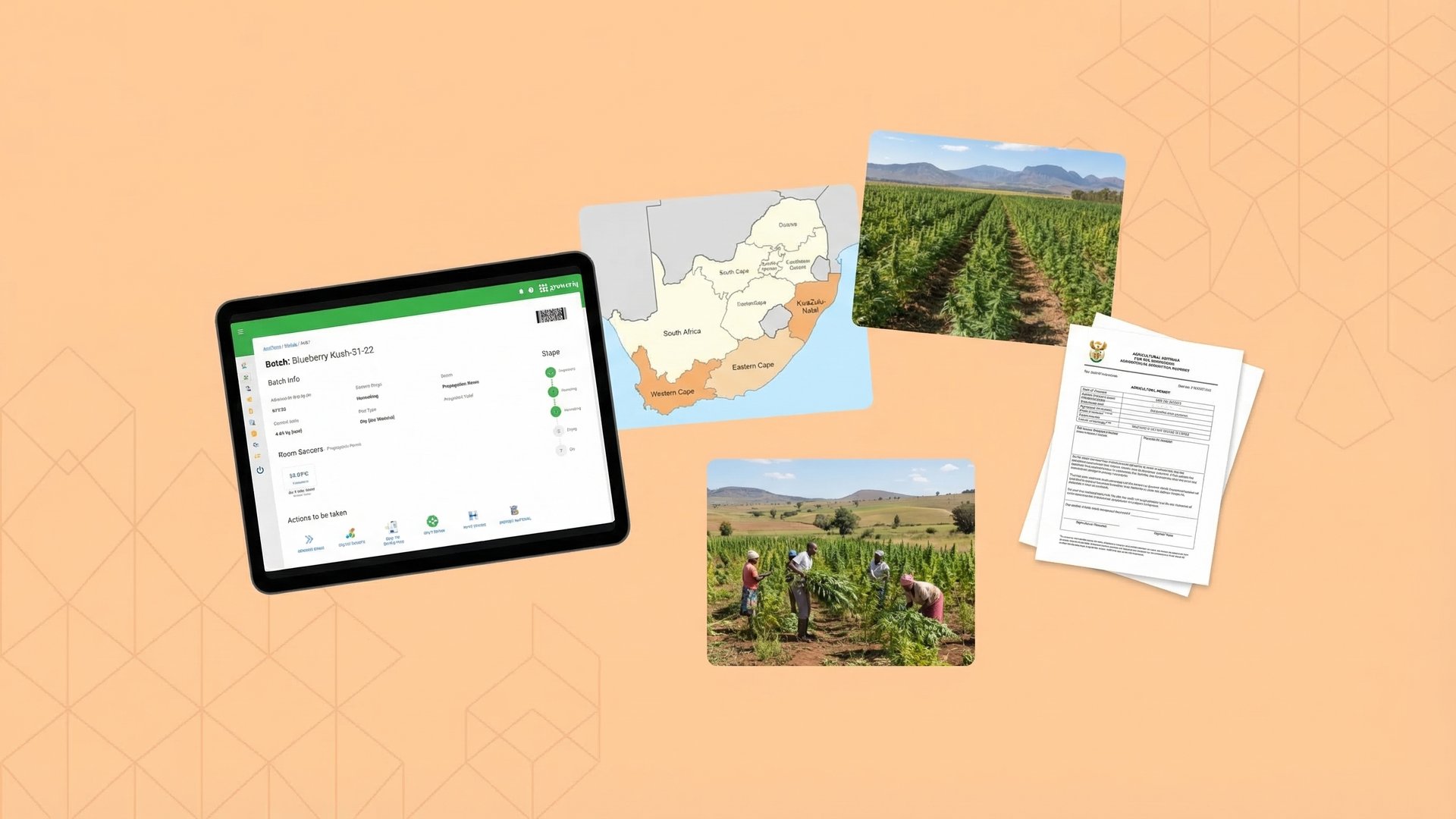
While South Africa hemp cultivation regulations are set nationally by DALRRD, the on-the-ground reality for growers varies dramatically across the country’s nine provinces. Climate, government investment, infrastructure, and extension services differ significantly. DALRRD organizes provinces into three coordination clusters for National Cannabis Master Plan implementation:
- Cluster 1: Gauteng, North West, Free State, Northern Cape
- Cluster 2: Western Cape, Eastern Cape
- Cluster 3: Mpumalanga, Limpopo, KwaZulu-Natal
KwaZulu-Natal: South Africa’s Most Active Hemp Province
KwaZulu-Natal leads the country in hemp activity by every measurable metric. The province has distributed 664 hemp and cannabis permits to farmers — the highest of any province — and has committed substantial public funding to the sector.
Provincial Master Plan allocations include:
- R47 million for cannabis research
- R10 million to assist farmers with production and permit applications
- R120 million in facilitated investment commitments
- R300,000 grants to local businesses providing processing, tunnels, lab equipment, packaging, testing, and marketing services
KZN’s summer rainfall climate is well-suited for outdoor hemp cultivation, and the province runs regular expos and farmer support programs through its Department of Agriculture and Rural Development (DARD).
Real success stories are emerging. Sphelele Shezi in the Umzinyathi District has built a hemp seed oil hair products business, while Nonhlanhla Qhoboshiyane in Durban has developed cannabis-based health products. These examples demonstrate that the South Africa hemp license system is translating into tangible economic activity on the ground.
Eastern Cape: Ambitious Development with International Partnerships
The Eastern Cape is pursuing arguably the most ambitious hemp development program in the country. The Eastern Cape Rural Development Agency (ECRDA), with Dr. Sunshine Blouw serving as cannabis specialist, has issued over 100 cultivation permits covering 1 to 50 hectares each.
Key developments include:
- Training delivered to over 100 prospective hemp producers
- An international partnership with French hemp experts via COBASA for seed breeding (France is a global leader in hemp genetics)
- Procurement of 6 tonnes of unlisted hemp seed varieties for research trials
- A long-term target of 50,000 cannabis farmers farming 2 hectares each, totalling 100,000 hectares of production
CSIR studies confirm the Eastern Cape is especially well-suited for hemp cultivation. The province has a strong focus on Black entrepreneur participation and is targeting diverse end-use sectors including construction materials, textiles, bio-composites, and ingestible products.
Western Cape: Controlled Environment Opportunity
The Western Cape presents a more nuanced picture. CSIR assessments confirm conditions are suitable for hemp growing, but there is an important caveat: the Western Cape is a winter rainfall region, which poses challenges for hemp varieties that thrive in summer rainfall conditions.
This makes the province better suited for greenhouse and indoor controlled-environment cultivation rather than large-scale outdoor operations. Hemp production trials are underway under the National Cannabis Master Plan, and Wesgro (the Western Cape investment and trade promotion agency) has hosted webinars on hemp regulatory frameworks to encourage industry participation.
For cultivators with the capital for controlled-environment facilities, the Western Cape offers strong infrastructure, research institutions, and market access advantages that offset its climate limitations.
Limpopo and Mpumalanga: Traditional Growing Regions
Both Limpopo and Mpumalanga fall within DALRRD Cluster 3 alongside KwaZulu-Natal. These provinces share favourable summer rainfall conditions and warm climates suited to outdoor hemp cultivation.
Limpopo is one of the primary regions for outdoor cultivation, but faces challenges including rural infrastructure gaps and limited extension services compared to KZN and the Eastern Cape. Mpumalanga, historically one of South Africa’s traditional cannabis-growing regions near the Eswatini border, is active in hemp permit applications through Cluster 3 coordination.
Both provinces represent strong potential for outdoor hemp operations, particularly for cultivators willing to invest in their own infrastructure rather than relying on provincial support programs.
Free State: Large-Scale Commercial Farming Potential
The Free State stands out for one compelling reason: it offers vast flat agricultural land ideal for mechanized, large-scale commercial hemp cultivation. Part of DALRRD Cluster 1, the Free State is particularly attractive for operations seeking economies of scale.
Demonstration trials are being conducted under the National Cannabis Master Plan, and the province’s agricultural infrastructure — developed over decades for grain and livestock farming — transfers well to commercial hemp operations.
North West: Community-Driven Cannabis Development
North West province has taken a distinctive community-driven approach to cannabis development. MEC Desbo Mohono has stated that “every avenue to create employment and fight poverty must be pursued,” and the province has acted on this commitment.
Key initiatives include:
- A Cannabis Lekgotla (consultative forum) that produced implementation recommendations
- Establishment of a dedicated Provincial Cannabis Structure to convene quarterly
- Partnerships with traditional leaders to ensure rural communities benefit from cannabis commercialization
- Demonstration trials underway as part of DALRRD Cluster 1
For additional context, Gauteng functions primarily as a processing, manufacturing, and distribution hub rather than a large-scale cultivation province. It is home to cannabis businesses and university-linked research programs. Northern Cape is in a trial phase with hemp production under the National Cannabis Master Plan, but its hot, arid conditions and water scarcity present constraints that likely require significant irrigation infrastructure.
How to Get a South Africa Hemp License: DALRRD and SAHPRA Pathways
Understanding the full scope of South Africa hemp cultivation regulations is essential before choosing your licensing pathway. For cultivators evaluating entry into South Africa’s hemp sector, two distinct licensing pathways exist. For a full walkthrough, see our detailed guide on how to get a cannabis license in South Africa.
Hemp Permit Application (DALRRD)
The DALRRD hemp permit is the primary pathway for commercial hemp cultivators. The application process works as follows:
- Obtain application form HP-FORM-001 from DALRRD or your provincial agriculture department.
- Submit the completed form with required documentation including site plans, land ownership or lease documents, and a business plan.
- DALRRD reviews the application and issues the permit through the Registrar of the Plant Improvement Act.
- Processing timeline varies from several weeks to months.
Requirements:
- Applicant must be 18 years or older
- Demonstrated agricultural competency
- No disqualifying criminal history
- Valid lease agreement or proof of land ownership
- Maximum 50 hectares per permit
- Application fee: R902
Seed certification is mandatory. Under the Hemp Certification Scheme approved in May 2024, all seed must be certified by a designated authority with proof of certification. If uncertified seed is used, applicants must request authorization for exemption from the Registrar, providing variety-specific information (lot number, mass, number of containers) and written motivation.
Medicinal Cannabis License (SAHPRA)
The SAHPRA Section 22C license is the pathway for medicinal cannabis cultivation, manufacturing, and research. This is a more rigorous and costly process:
| Requirement | Detail |
|---|---|
| Application fee | R23,980 |
| Legal consulting | ~R3,180 per application |
| Review timeline | 12–24 months typical |
| License validity | 5 years |
| Facility standard | GMP-compliant with security infrastructure |
| Documentation | Site plans, master files, batch tracking system, document management system |
SAHPRA licensing requires facility setup prior to application, making it a capital-intensive pathway. Since 2022, SAHPRA has issued 83 cannabis licenses, 4 manufacturing licenses, 120 export licenses, and 30 research permits — demonstrating that the pipeline is active but selective.
Compliance Requirements Under SAHPRA Hemp Rules and DALRRD Permits
Maintaining regulatory compliance for cannabis growers in South Africa requires meticulous documentation. Whether operating under a DALRRD hemp permit or a SAHPRA license, the record-keeping obligations are substantial.
Record-Keeping Obligations
Permit and license holders must maintain comprehensive documentation including:
- Location of cultivation and name of the person in charge
- Details of crops previously grown at the location
- Nature, origin, and quantity of herbal starting materials
- All chemicals and substances used during cultivation
- Environmental conditions during growing
- Harvesting dates, conditions, and methods
- Yield documentation per batch
- Post-harvest processing records
- Storage and transport logs
This level of detail is precisely where cannabis compliance software delivers value. Manual record-keeping across these categories — especially for multi-site operations spanning different provinces — creates compliance gaps that risk permit revocation. GrowerIQ’s seed-to-sale platform automates batch-level tracking of every process and procedure, directly mapping to what DALRRD and SAHPRA inspectors require.
THC Testing and Seed Certification
Under the new SAHPRA hemp rules and DALRRD regulations, crops must not exceed 2% THC in leaves and flowering heads. Ongoing crop monitoring is required, and non-compliance can result in permit revocation and enforcement action. THC testing labs and services are emerging across the country, particularly in KZN and Gauteng.
The Hemp Certification Scheme, approved in May 2024, regulates varietal integrity and quality of propagation material. SANSOR (South African National Seed Organisation) oversees certification. All seed must carry proof of certification documentation, and uncertified varieties require a special exemption application with detailed supporting information.
CBD Product Compliance
For cultivators targeting the CBD market, additional compliance layers apply. SAHPRA regulates CBD products, requiring a Section 22C license for manufacturing and distribution. Only minor daily dosages of pure CBD (generally under 20 mg/day) are exempt from scheduling. Making unproven health or medical claims about CBD products risks product seizure and criminal liability.
South Africa Dagga Regulations 2026: What’s Coming Next
The regulatory landscape for cannabis and hemp in South Africa is evolving rapidly. Understanding the South Africa dagga regulations 2026 timeline is essential for cultivators planning their operations.
Completed Regulatory Milestones
| Date | Change |
|---|---|
| May 29, 2024 | Cannabis for Private Purposes Act signed into law |
| May 2024 | Hemp Certification Scheme approved by Minister of Agriculture |
| December 1, 2025 | New Plant Improvement Act raises hemp THC limit from 0.2% to 2% |
| February 3, 2026 | Draft regulations for private cannabis use published (750g possession limit, max 5 plants per adult) |
| March 5, 2026 | Public comment period closed on draft private use regulations |
The 2026–2027 Regulatory Calendar
| Expected Date | Change |
|---|---|
| April 2026 | Hemp and Cannabis Commercialisation Policy expected for Cabinet approval and public comment |
| End of March 2026 | Government aims to finalize commercial cannabis and seed regulations |
| Mid-2027 | Overarching Cannabis Bill to be presented to Parliament (covering private use, commercial cultivation, manufacturing, and research) |
The DTIC has taken over the National Cannabis Master Plan to centralize policy and accelerate implementation. The global hemp market is projected to grow 17.3% annually between 2025 and 2032, and South Africa’s cannabis market could reach an estimated R40 billion at maturity. The sector already employs over 90,000 people, with significant impact in rural communities.
For cultivators, the most important upcoming development is the Commercialisation Policy expected in April 2026. The upcoming Commercialisation Policy will further reshape South Africa hemp cultivation regulations by creating new commercial pathways for producers. This policy will open new commercial pathways beyond the current hemp permit and medicinal license tracks, potentially creating opportunities in retail, adult-use, and export markets that do not currently exist.
How GrowerIQ Helps South African Hemp Cultivators Stay Compliant
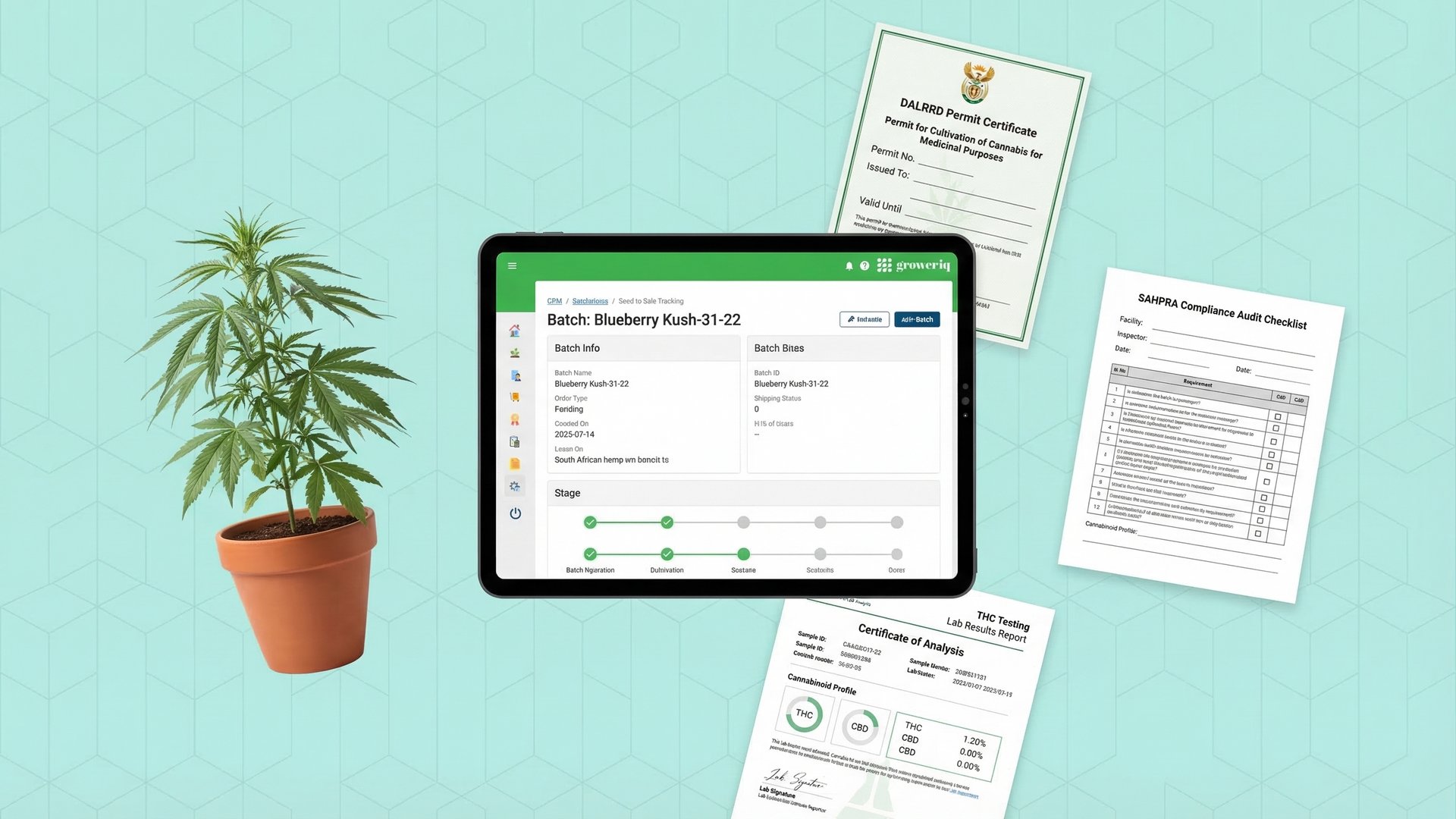
As South Africa’s hemp regulations grow more complex — with the new 2% THC threshold, evolving SAHPRA hemp rules, and the Commercialisation Policy on the horizon — cultivators and processors need systems that scale with compliance demands. GrowerIQ’s seed-to-sale platform is purpose-built for cultivators and processors navigating exactly this kind of regulatory environment.
- Batch-level record keeping that tracks every process affecting product quality, directly mapping to DALRRD and SAHPRA documentation mandates.
- THC compliance monitoring that maintains the precise testing and monitoring paper trail required under the new 2% threshold regime.
- Seed certification tracking for lot numbers, quantities, and provenance required by the Hemp Certification Scheme.
- Multi-site provincial management providing centralized oversight for operations spanning different provinces with varying climatic conditions and support infrastructure.
- Export documentation supporting the chain-of-custody tracking needed for international trade, including AfCFTA access to African, Asian, and Middle Eastern markets.
- Automated regulatory reporting that generates compliance reports for DALRRD and SAHPRA, reducing administrative burden and helping avoid permit revocation.
Early adoption of compliance software positions South African hemp cultivators to scale operations without compliance gaps as the industry targets 10% annual growth and the Commercialisation Policy opens new commercial pathways in 2026 and 2027.
Ready to navigate South Africa’s hemp regulations with confidence? Learn how cannabis compliance software can protect your operation and streamline regulatory reporting across provinces.
Key Takeaways
- South Africa raised its hemp THC limit to 2% in December 2025 — the highest in the world — making commercial hemp cultivation significantly more viable and reducing non-compliance risk.
- Hemp cultivation regulations are national (DALRRD permits), but provincial conditions vary: KwaZulu-Natal leads with 664 permits and R47M in research funding; Eastern Cape targets 100,000 hectares; Free State offers mechanized large-scale potential.
- Two licensing pathways exist: DALRRD hemp permits (R902, max 50 hectares) for industrial hemp, and SAHPRA Section 22C licenses (R23,980, 12–24 months) for medicinal cannabis.
- The Commercialisation Policy (April 2026) and Overarching Cannabis Bill (mid-2027) will reshape South Africa hemp cultivation regulations and the commercial landscape — cultivators should prepare now.
- Compliance software like GrowerIQ addresses the detailed record-keeping, THC monitoring, seed certification tracking, and multi-site management that South Africa’s evolving hemp regulations demand.
Frequently Asked Questions
What is the legal THC limit for hemp in South Africa in 2026?
As of December 1, 2025, the legal THC limit for industrial hemp in South Africa is 2% in the leaves and flowering heads. This was raised from 0.2% under the new Plant Improvement Act No. 11 of 2018, making South Africa the only country in the world to allow more than 1% total THC for industrial hemp.
How do I apply for a hemp permit in South Africa?
You apply using form HP-FORM-001 from DALRRD or your provincial agriculture department. Requirements include being 18 or older, demonstrating agricultural competency, having no disqualifying criminal history, and providing proof of land ownership or a valid lease agreement. The application fee is R902 and permits cover up to 50 hectares.
Which South African province is best for hemp farming?
KwaZulu-Natal is currently the most active province with 664 permits issued and R47 million in cannabis research funding. Eastern Cape is also strong with ECRDA-led development programs and international partnerships. Free State offers the best potential for large-scale mechanized cultivation. Western Cape is better suited for controlled-environment (greenhouse or indoor) cultivation due to its winter rainfall pattern.
What is the difference between a SAHPRA license and a DALRRD hemp permit?
A DALRRD hemp permit (R902) allows cultivation of industrial hemp under 2% THC for agricultural and commercial purposes under the Plant Improvement Act. A SAHPRA Section 22C license (R23,980) is required for medicinal cannabis cultivation, manufacturing, or research, involves a 12–24 month review process, and requires GMP-standard facilities. They are separate regulatory tracks governed by different laws and agencies.
Ready to Manage South Africa Hemp Compliance?
GrowerIQ’s compliance software helps South African hemp cultivators track every plant, meet SAHPRA and DALRRD requirements, and export audit-ready records.
REQUEST DEMO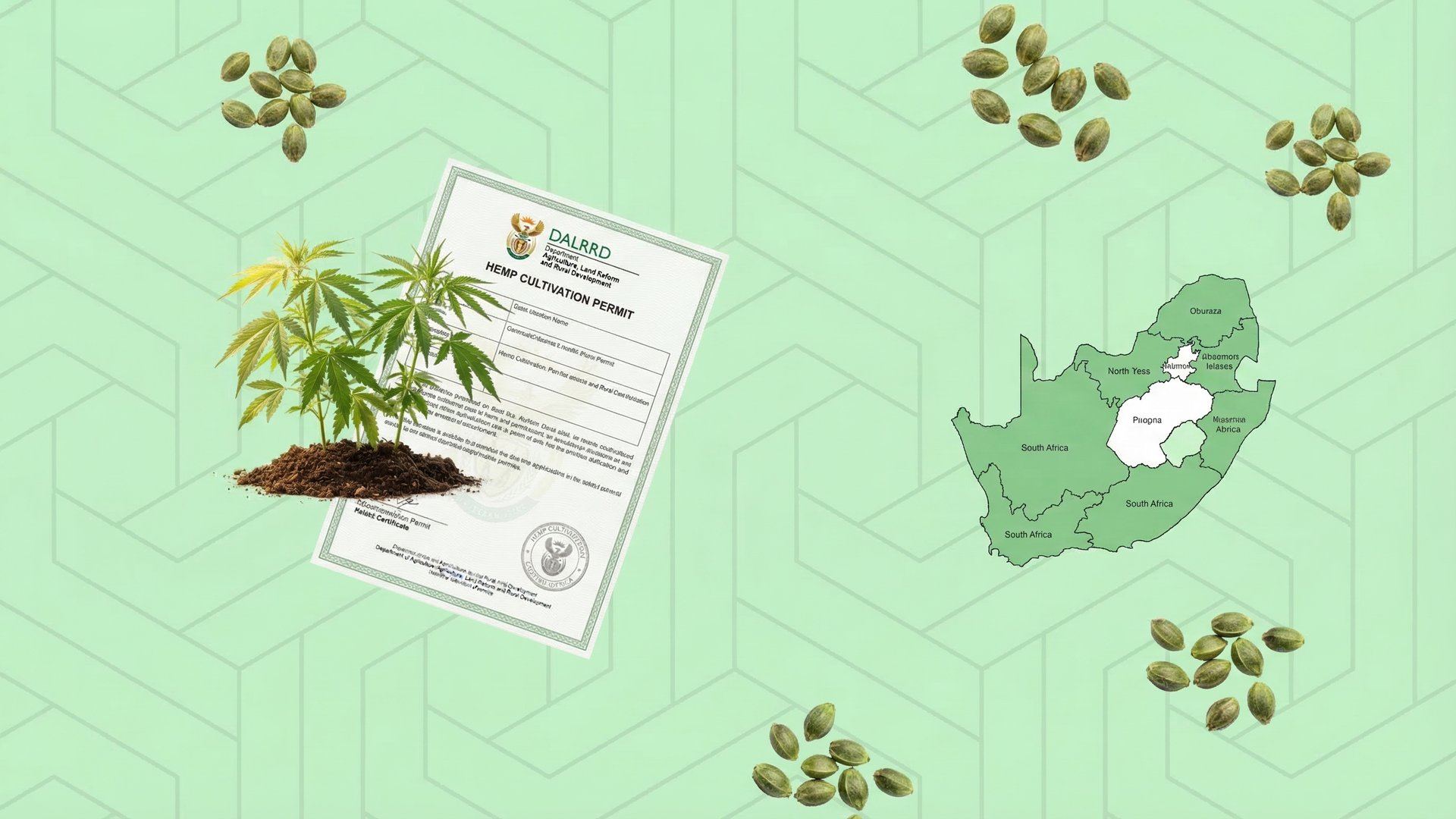
Recommended For You
Portugal’s Cannabis Exports Triple: 42 Tonnes to Germany and Growing as Europe’s Processing Hub
April 22, 2026UK Medical Cannabis Prescriptions Surge 262%: 80,000 Patients and a GBP 500M Private Market
April 21, 2026Poland: Europe’s Quiet Cannabis Giant with 105,000 Patients and 5 Tonnes Dispensed in 2025
April 20, 2026About GrowerIQ
GrowerIQ is changing the way producers use software - transforming a regulatory requirement into a robust platform to learn, analyze, and improve performance.
To find out more about GrowerIQ and how we can help, fill out the form to the right, start a chat, or contact us.